A poisonous seed
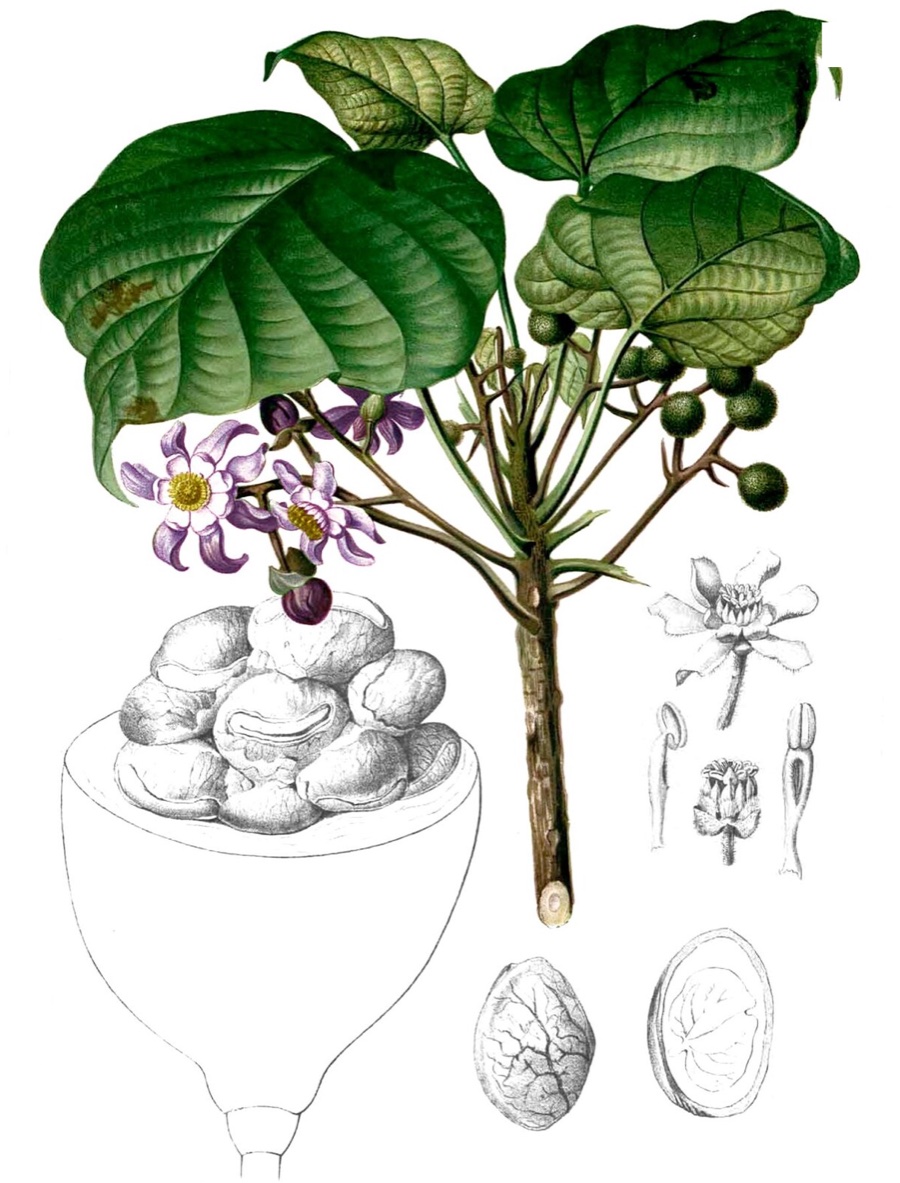
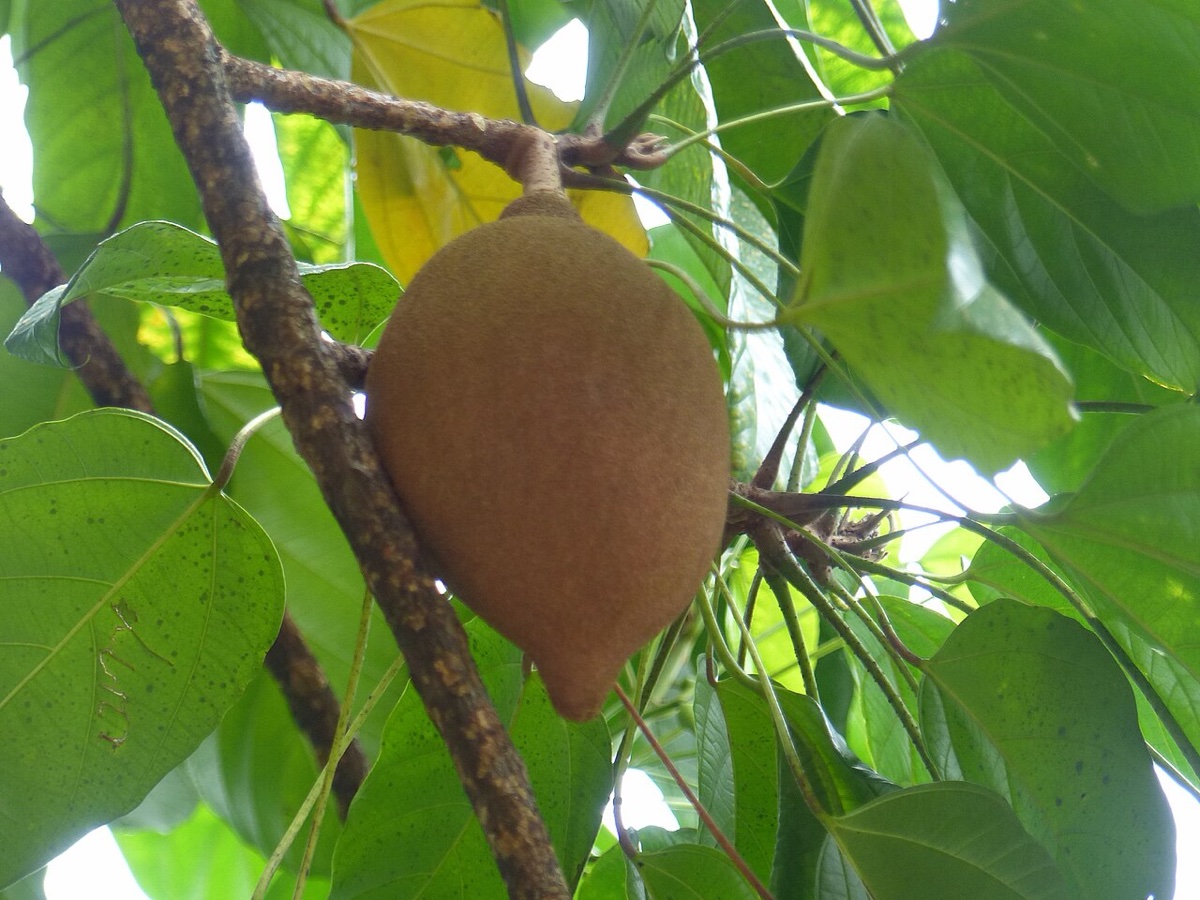
Pangium edule is the only species in its genus. It is a big forest tree that can reach 40 metres, with large heart-shaped leaves on long stalks, and most trees are either male or female. The fruit is brown, rough and egg-shaped, usually 15 to 25 centimetres long, and hangs from a curved stalk. It never splits open. An average fruit weighs about a kilogram, a big one up to 2.5 kilograms, and inside are anywhere from about ten to forty seeds packed tightly together.
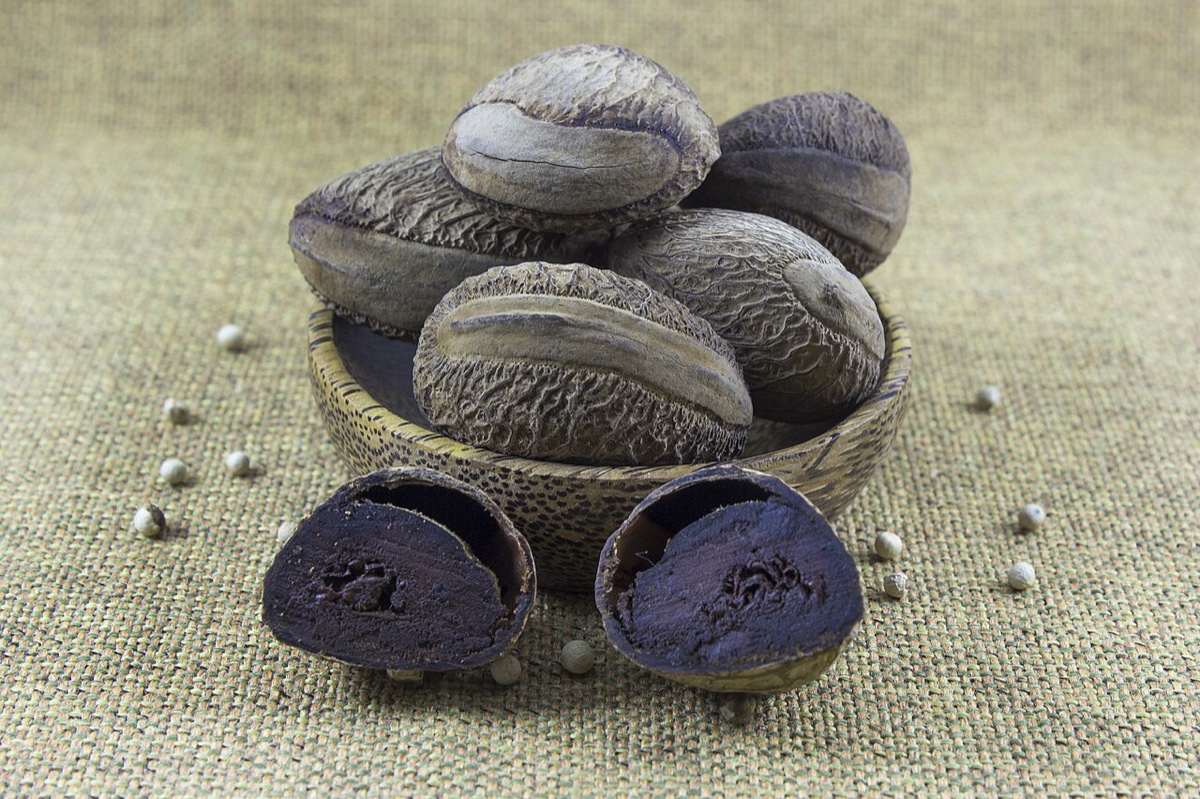
Each seed is roughly triangular, 4 to 6 centimetres long, with a very hard shell around a thick, oily kernel. That kernel is the part that becomes kluwak. The seeds also float, and rivers and sea currents can carry them a long way.
The names vary by island. In standard Indonesian the spice is keluak; the dictionary lists kluwak and keluwek as non-standard spellings, and kluwek is also common. The tree is kepayang, also called pucung in Javanese, picung in Sundanese and pangi. In Makassar it is kaloa, and in Singapore and Malaysia, buah keluak. The Indonesian idiom mabuk kepayang, "drunk on kepayang", means head over heels in love; taken literally, the dictionary says, it means drunk from eating kepayang fruit.
The Latin species name, edule, means "edible". In the 1890s Melchior Treub, director of the botanic garden at Buitenzorg (now Bogor), wrote that despite its name the plant had always been thought dangerous, because of a highly toxic substance in all its parts. Botanists once placed it in the Flacourtiaceae, and before that the Bixaceae. Today it sits in the Achariaceae.
Why it is poisonous
Every part of the tree contains gynocardin, a cyanogenic glycoside. When the tissue is crushed or damaged, an enzyme splits it, and the breakdown product releases hydrogen cyanide.
People knew the plant was dangerous long before anyone knew why. Treub's study begins with that history. According to Treub, the naturalist Rumphius, who worked on Ambon, had already noted that the powdered bark thrown into water killed fish, that chickens died from eating the seeds, and that cattle on Bali died after eating the leaves. In 1855 a writer named Filet, describing the garden of the military hospital in Batavia, wrote that freshly opened seeds gave off a strong smell of cyanogen. Around 1890 the chemist Greshoff, working at Buitenzorg, found hydrogen cyanide in the seeds, leaves, bark and fruit: "in short, in all parts of the plant", in Treub's words (our translation).
Fresh seeds can kill if eaten without processing. The South-East Asian plant handbook PROSEA describes badly prepared seeds causing sleepiness, headache and a kind of intoxication or delirium that may end in death. A 1943 US War Department manual on emergency food plants of the Pacific listed the tree among plants whose seeds may be eaten, then warned that the seeds were "very poisonous" and told readers to get help, if possible, from local people who knew how to prepare them.
"This fruit really is poisonous. It kills people if eaten fresh, because it contains cyanide. That's why, after the harvest, the fruit is usually stored. Then the seeds are taken out, collected, washed clean and boiled." Nuri Andarwulan, food scientist, IPB University, quoted by Kompas, 2021 (our translation)
From seed to kluwak
The kluwak sold in markets is made by producers and has already been through this process. What follows describes how they do it; it is not a recipe, and raw or under-processed seeds remain poisonous.
The seeds are boiled, then buried for about forty days. The official Indonesian dictionary defines keluak as seeds "boiled until cooked and ripened in ash for a month". Nuri Andarwulan of IPB describes seeds boiled in a big pot, then drained, cooled and buried with ash in a bucket or drum for forty days; another account, from the 2014 laboratory study below, has the seeds soaked as well as boiled before the burial. In the past, she says, people buried them near the clay cooking stove, and the colder the room, the longer it takes. In Umpungeng, a village in Soppeng, South Sulawesi, villagers bury the pangi in the soil for forty days, according to a 2017 study. A 2014 laboratory study that copied the method soaked and boiled the seeds, then buried them under wood ash in pits for up to forty days.
Each step does a job. Heat destroys the enzyme that frees the cyanide, washing carries off the glycoside, which dissolves in water, and during fermentation microbes break the gynocardin down. Studies find that boiling removes much of the cyanide and that weeks of burial remove nearly all of it. A 2017 study from Makassar found that rice-husk ash cut cyanide more than plain soil did, and that the longer the burial, up to sixty days, the lower the cyanide.
Underground, the kernel changes colour, from milky white to dark brown and then black. Researchers who repeated the process concluded that the darkening was most likely non-enzymatic browning: the Maillard reaction, which they note also takes place in soy sauce and coffee. Not every batch works. Failed kluwak tastes bitter, and Nuri Andarwulan says the bitterness can mean cyanide is still there; a burial that is too cold is one cause.
Burial is what makes kluwak, the black spice. Elsewhere the seed is prepared other ways. The Obu Manuvu of Mindanao in the Philippines eat the seeds after their own village method of washing, boiling and soaking them in a river; a 2023 study of that method measured about 99 percent less cyanogenic glycoside afterwards. In Sarawak, kernels are traditionally sliced, boiled, then soaked in running water. And according to Nuri Andarwulan, Sundanese cooks in West Java use dage picung, seeds that are boiled and soaked but never buried, which stay a pale yellowish white and go into coconut-milk dishes such as sayur lodeh.
How it tastes
Good kluwak flesh is soft, oily and glossy black, or a very dark red-black. It is rich in fat, about 42 percent in dried samples, mostly oleic and linoleic acids. In a pot it adds a deep savoury taste, gurih in Indonesian, and turns the food brown to black. Singapore's Chinese Cultural Centre describes the nut as "chestnut-like", lending "a deep, earthy smokiness". Indonesia's tourism ministry describes a slight bitterness as part of its taste, while Nuri Andarwulan treats a clearly bitter taste as the sign of a failed batch.
Where it grows
Kew's World Checklist gives the tree a wide native range, from the Nicobar Islands and Malaya through the Philippines, all of Indonesia and New Guinea to the Solomon Islands, Vanuatu, Micronesia and the Bismarck Archipelago. It is native to every main island group of Indonesia. PROSEA describes it in primary and secondary rainforest, usually as scattered single trees, along riverbanks and in teak forest, mostly below 300 metres and occasionally up to about 1,000.
It is mostly a wild or semi-wild tree, sometimes kept in villages, and is not grown commercially as a plantation crop. Trees take years to bear, often around fifteen. In 2001 PROSEA noted processed kluwak for sale in markets across Indonesia, especially in Java and wherever Javanese or Sundanese migrants live. The studies and reports we read record the seeds being gathered, processed or used in Bogor (West Java), Padang Pariaman (West Sumatra), Nganjuk (East Java), Soppeng (South Sulawesi) and Boalemo (Gorontalo). We found no national production figures, and PROSEA (2001) notes that international trade statistics are not available. Our label gives Java as the locality because that is where most of the market and most of the dishes are, not because the tree grows only there.
In the Indonesian kitchen
Cooks usually crack the shell with a stone pestle, scoop out the black flesh, soften it with a little hot water and grind it with the other spices; one hotel chef in Surabaya strains the paste so that no shell or grit gets into the soup. Indonesian food writers and dictionaries name kluwak in:
- Rawon, the beef soup of East Java. The dictionary calls keluak its main seasoning, and the black of the broth comes from kluwak, not soy sauce.
- Nasi pindang from Kudus and nasi gandul from Pati, in Central Java. Both use keluak with coconut milk, so the broth is browner than rawon.
- Brongkos, from Yogyakarta, looks like rawon at first glance, but adds coconut milk, cowpeas (kacang tolo), tofu and tempeh.
- Sop konro, the beef-rib soup of Makassar, with kluwak in its black spice base.
- Pallu kaloa, also from Makassar: fish, usually snapper, in a dark broth. Kaloa is the local word for kluwak. One Makassar restaurant family traces the dish to their grandfather, who began cooking it in the 1950s.
- Gabus pucung, a Betawi (old Jakarta) dish of snakehead fish in a thick black kluwak broth. Indonesia's tourism ministry calls it nearly lost, though still served around Depok and Bekasi.
- Sayur kluwak, and bumbu rawon, the spice mix for rawon, for which kluwak is sold in markets.
The seed crossed into Peranakan cooking too. In Singapore and Malaysia, ayam buah keluak is chicken cooked with the nuts (there is a pork version, babi buah keluak). Singapore's Chinese Cultural Centre says it was served at Peranakan wedding feasts, a symbol of fertility. The same source says the Singapore restaurant Candlenut became, in 2016, the first Peranakan restaurant to win a Michelin star, and lists buah keluak ice cream among its dishes.
Other uses
Fishers have used the ground kernels to keep fresh fish from spoiling, layered between the fish or packed into the gutted belly, and Indonesian researchers have reported fish kept this way for several days. Lab studies find seed extracts active against fungi and fish-spoilage bacteria. The pounded bark and unripe seeds have served as a fish poison, and the pounded leaves to stun shrimp; fresh leaves were also used to keep meat and game, and as an antiseptic and insect repellent.
Oil from the kernels can stand in for coconut oil in cooking, and in one Gorontalo village people still use it that way. Among the Iban of Borneo, PROSEA records the seed oil as the main preservative in traditional weaving. The yellow wood, which has an unpleasant smell and does not last, was used for matchsticks.
Swaps
Buying and storing
Choose nuts with unbroken shells. The kernel is so oily that a cracked shell lets in air and the flesh goes rancid. Shells that look shrivelled and very dry have probably sat at the stall too long, and the flesh will stick to the shell. Inside, good kluwak is glossy and very dark, with no mould and no off smell. One Yogyakarta chef prefers mature nuts, because young kluwak moulds faster and tastes harsher.
Cooks shake kluwak before buying, but they disagree about what to listen for. That chef says a mature, moist nut makes no sound, while other cooks want to hear the kernel move; several warn against a loud, dry rattle.
Keep whole nuts unopened on an airy shelf, not in a closed jar or bucket, where they sweat and go mouldy. Stored this way, the same chef says, they keep for about a month. Once shelled, use them soon.
Still debated
- How much cyanide is in a fresh seed? Published figures differ by orders of magnitude, depending on the study, the method and which part of the plant was measured. They agree that fresh seeds hold enough to be dangerous, so we print no number.
- How long is the burial? A month, says the dictionary; about forty days, say most sources; one study compared forty, fifty and sixty days and found sixty best. Cold slows the process down.
- Ash, earth, or both? Wood ash in a pit, rice-husk ash, plain soil, or ash in a drum: practice varies by place and producer, and some add a soak of several days.
- What does the shake test tell you? Silence may mean a moist, mature kernel; a soft knock may mean a kernel that has come away from the shell and is easy to scoop. Treat it as market lore, not a rule.
- How long has kluwak been in rawon? Singapore's Chinese Cultural Centre, citing a 2022 article by Khir Johari, says keluak was used in Javanese dishes as early as the 12th century. Writing in The Peranakan magazine, Peter Lee replied to Khir Johari that the 12th-century text mentions a dish called rarawwan but not keluak, and that an 1845 Batavia cookbook gives two rawon recipes without it. We have not checked those texts ourselves. When kluwak first went into rawon is not known.
- Fridge or no fridge? One chef refrigerates shelled kluwak in a closed box; another source says never to put it in the fridge, because it dries out.
Sources
- IPNI, Pangium edule Reinw. ipni.org
- Royal Botanic Gardens, Kew, World Checklist of Vascular Plants, via GBIF. gbif.org
- Stevens, P. F. Angiosperm Phylogeny Website: Malpighiales (Achariaceae). Missouri Botanical Garden. mobot.org
- Roemantyo & Zuhud, E. A. M. (2001). Pangium edule Reinw. In Plant Resources of South-East Asia 12(2): Medicinal and poisonous plants 2. PROSEA Foundation, Bogor. prosea.prota4u.org
- National Parks Board, Singapore. Pangium edule. Flora & Fauna Web. nparks.gov.sg
- Kamus Besar Bahasa Indonesia (KBBI Daring): keluak, kepayang, pucung, pangi, rawon, konro, kacang tolo, mabuk kepayang. kbbi.kemendikdasmen.go.id
- Treub, M. (1896). Sur la localisation, le transport et le rôle de l'acide cyanhydrique dans le Pangium edule Reinw. Annales du Jardin Botanique de Buitenzorg 13. archive.org
- Merrill, E. D. (1917). An Interpretation of Rumphius's Herbarium Amboinense. Manila: Bureau of Printing. archive.org
- Merrill, E. D. (1943). Emergency Food Plants and Poisonous Plants of the Islands of the Pacific. Washington, D.C.: U.S. War Department. archive.org
- Voon, B. H. & Kueh, H. S. (1999). The nutritional value of indigenous fruits and vegetables in Sarawak. Asia Pacific Journal of Clinical Nutrition 8(1): 24–31. apjcn.nhri.org.tw
- Samudry, E. G., Sukainah, A. & Mustarin, A. (2017). Analisis kualitas kluwek (Pangium edule Reinw) hasil fermentasi menggunakan media tanah dan abu sekam. Jurnal Pendidikan Teknologi Pertanian 3(1): 25–33. ojs.unm.ac.id
- Santoso, M., Yamaguchi, T., Matoba, T. & Takamura, H. (2014). Effects of pit fermentation and thermal cooking process on the antioxidant activity and components of Pangium edule seeds. Journal of Cookery Science of Japan 47(4): 202–213. doi.org
- Listyorini, K. I., Kusumaningrum, H. D. & Lioe, H. N. (2021). Antifungal activity and major bioactive compounds of water extract of Pangium edule seed against Aspergillus flavus. International Journal of Food Science 2021: 3028067. PMC
- Andarwulan, N., Fardiaz, D., Wattimena, G. A. & Shetty, K. (1999). Antioxidant activity associated with lipid and phenolic mobilization during seed germination of Pangium edule Reinw. Journal of Agricultural and Food Chemistry 47(8): 3158–3163. PubMed
- Villame-Gayagas, R. G. E. et al. (2023). Village-level processing of pangi (Pangium edule Reinw.) seeds by the Obu Manuvu improves the edibility and level of some nutritional factors. The Philippine Agricultural Scientist 106(4). ukdr.uplb.edu.ph
- Paino, C. (17 Jan 2022). Istilah mabuk kepayang berasal dari buah ini. Mongabay Indonesia. mongabay.co.id
- Kasih, A. P. (23 Apr 2021). Benarkah rempah kluwek mengandung sianida? Ini kata pakar IPB. Kompas.com. kompas.com
- Tiofani, K. (22 Apr 2021). Proses hilangkan sianida dari biji picung jadi kluwek. Kompas.com. kompas.com
- Tiofani, K. (22 Apr 2021). 3 tips beli kluwek tua untuk masakan enak. Kompas.com. kompas.com
- Tiofani, K. (19 Apr 2021). 2 cara simpan kluwek agar tidak lembab dan jamuran. Kompas.com. kompas.com
- Agmasari, S. (22 Oct 2020). Tips pilih kluwek yang bagus dan cara buka kluwek (from Sajian Sedap). Kompas.com. kompas.com
- Khairunnisa, S. N. (27 Jun 2021). Cara masak pakai kluwek, agar tidak jadi "rawon kotor". Kompas.com. kompas.com
- Khairunnisa, S. N. (4 Jul 2020). Mengenal kluwek, rempah khas untuk rawon yang mengandung asam sianida. Kompas.com. kompas.com
- Tiofani, K. (17 Jan 2022). 6 cara membuat rawon empuk dan enak, olah kluwek dengan benar. Kompas.com. kompas.com
- Apriliani, M. (16 Jun 2025). Resep rawon daging sapi bumbu sederhana dan cara mengolah kluwek. Kompas.com. kompas.com
- Fridayani, N. (10 Aug 2020). Bedanya rawon, nasi pindang, dan nasi gandul sama-sama pakai kluwek. Kompas.com. kompas.com
- Aisyah, Y. (2 Nov 2020). Resep brongkos daging sapi, sayur kuah santan pakai keluak. Kompas.com. kompas.com
- Istiqamah, N. (11 Aug 2022). Sejarah pallu kaloa: dari resep coba-coba jadi kuliner khas Makassar. detikSulsel. detik.com
- Kementerian Pariwisata. Gabus pucung: kuliner Betawi dengan kuah kental hitam. Indonesia.travel. indonesia.travel
- The Nutgraf Editorial Team. Peranakan Chinese food in Singapore. Culturepaedia, Singapore Chinese Cultural Centre. singaporeccc.org.sg
- Lee, P. (13 Dec 2025). The meat of the matter. The Peranakan magazine, The Peranakan Association Singapore. peranakan.org.sg